For veterans · The Warrior Class
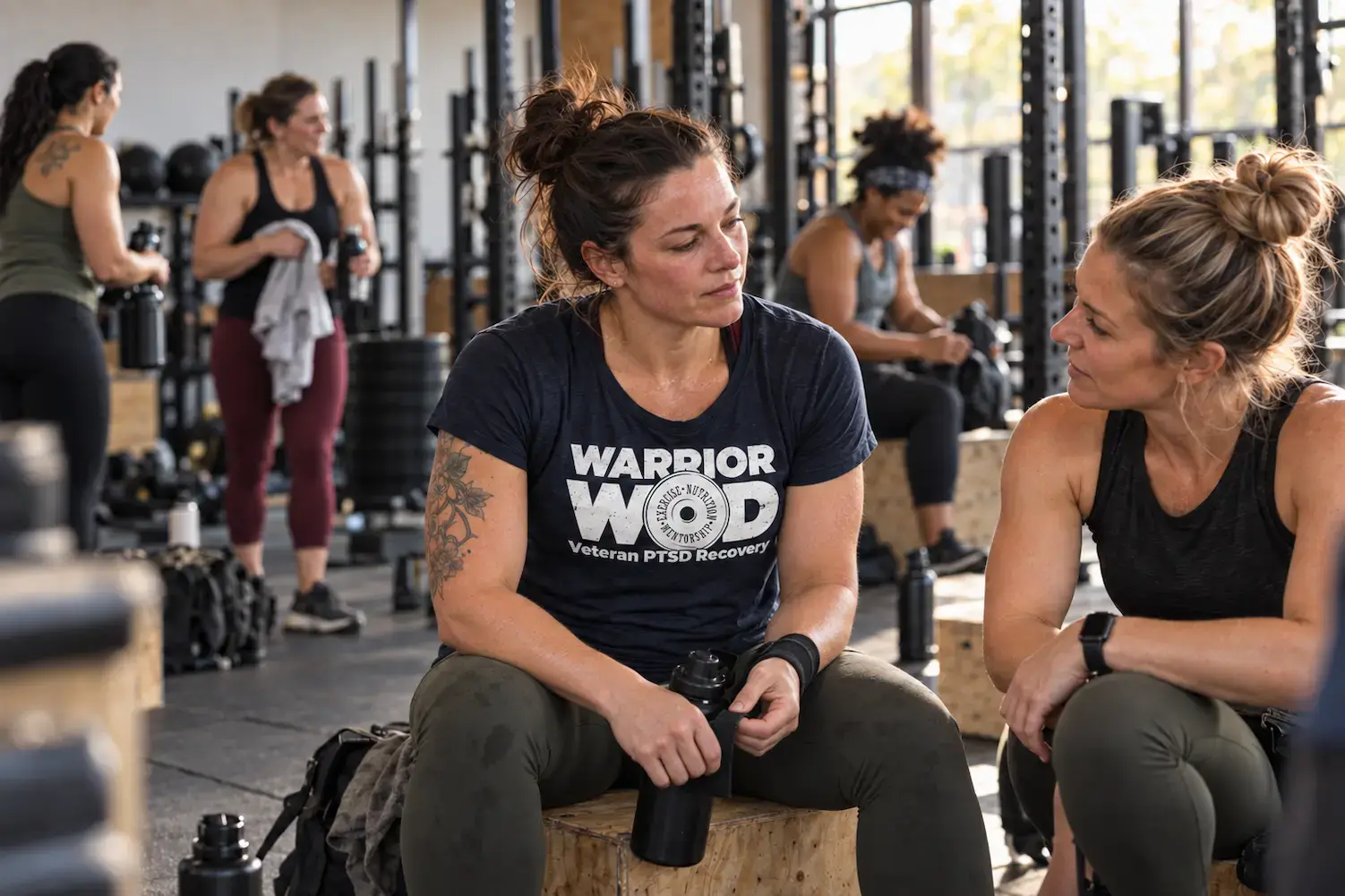
WarriorWOD’s six-month veteran PTSD program gives you exercise, nutrition coaching, and peer mentorship from a Battle Buddy who completed the program. You train three times a week. We check in every month and track what changes.
Warriors who complete the program see a 14.42-point drop in PTSD symptoms, independently verified by the College of Charleston.
“WarriorWOD taught me that I’m capable of overcoming my mental barriers.”
Application status
More veterans applied than we can fund right now. Leave your email and you’ll hear from us the day applications reopen.
Not a veteran? $125/month funds one veteran’s complete six-month recovery. Become a monthly donor.
We’ll only email you about Warrior Class applications. Unsubscribe anytime.
Sound familiar?
Most veterans who come through WarriorWOD recognize a few of these. So do the Battle Buddies, because they came through first. This is veterans helping veterans. You won’t have to explain yourself to someone who wasn’t there.
What veterans receive
The WarriorWOD veteran PTSD program is a six-month, donor-funded recovery program for US military veterans living with PTSD, suicidal ideation, or substance misuse. You train three times a week at a gym you pick, work with a certified Nutrition Coach, and stay in contact with a Battle Buddy who already finished the program.
WarriorWOD Foundation combines exercise, nutrition, and peer mentorship in a research-backed, results-driven six-month recovery program for US military veterans suffering from post-traumatic stress, suicidal ideation, and substance misuse.
A membership at the gym you choose, set up before your class starts. Every workout scales to you: Rx, Scaled, Masters, or Beginner.
24 one-on-one sessions with a certified Nutrition Coach. Small habits, starting from what you eat now.
A veteran who completed WarriorWOD and is trained in VA S.A.V.E. A text every week, a call every two weeks, and face to face once a month if you live close enough.
A Monthly Survey with the PCL-5 and C-SSRS safety screen, reviews at Weeks 13 and 26, and an InBody scan at intake and graduation. You watch your own numbers move.
What it takes
In practice, the six-month veteran PTSD program asks a lot. You sign a program agreement before you start, and it covers two things: the plan we build with you, and the minimum you have to hit to stay in good status. Aim for the plan. Never drop below the minimum without telling someone.
Missing a requirement doesn’t get you cut. It starts a conversation. Nothing happens without someone calling you first.
Your Battle Buddy or Program Director reaches out within 3 business days to find out what’s going on. Then you get a written note: which requirement, what needs to change, and by when (usually 14 days).
If it happens again within 30 days, or you don’t answer the notice, you sit down with your Program Director for 30 minutes. Your Battle Buddy can join. You leave with a Grace Plan or a Pause Plan.
Continue with a Grace Plan. Pause and re-enter the next Warrior Class with a fresh start. Or, after repeated non-engagement, disenroll. Even then, the door stays open for a future class.
Violence, threats, harassment, weapons, or falsifying safety information skip straight to a decision.
How it works
Tell us about your service and what’s going on now. Discharge status doesn’t matter. We review every application.
As your Warrior Class gets close, we call you. You ask your questions, we ask ours.
Sign the program agreement. Finish intake (PCL-5, C-SSRS, health and nutrition baseline) and list your current providers so we can coordinate. We set up your gym and match you with your Battle Buddy and Nutrition Coach.
Your whole Warrior Class starts the same day. You begin the 12 orientation modules and set one goal you’d bet a friend on.
Train, eat, connect, report honestly. At Week 13 you sit down with your Program Director to review your numbers and adjust the plan.
Week 26. Final review and InBody scan. You don’t have to be fixed. You have to have walked the 26 weeks. Alumni check-ins follow at 30, 60, and 90 days.
Optional. Graduates can serve as a Battle Buddy, a Nutrition Coach candidate, or an Ambassador. Read about the Battle Buddy program.
Why it works
Training is a primary treatment for PTSD symptoms, not an add-on.
On PTSD and exercise, the mechanism is documented. Aerobic training regulates the HPA axis, promotes BDNF production, and reduces neurobiological hyperarousal: the three mechanisms driving most PTSD symptom clusters.
A 2023 British Journal of Sports Medicine meta-analysis found exercise 1.5 times more effective than medication for depression.
What you eat changes how your brain handles stress.
Omega-3 fatty acids reduce the neuroinflammation linked to both PTSD and depression. Anti-inflammatory diets lower cortisol dysregulation. Stable blood glucose supports the executive function that veterans lose to hypervigilance.
A 2023 Nature Mental Health study tied Mediterranean-style eating to reduced PTSD symptom severity.
Veterans don’t distrust treatment. They distrust people who weren’t there.
Every Battle Buddy is a veteran who completed the WarriorWOD program. It’s peer support for veterans from people who’ve done the same six months you’re about to start.
Tsai et al. (2016) found veterans with peer mentors show 35% greater PTSD symptom reduction and 27% less depression than those without.
See how the three parts fit together in the WarriorWOD program
The results
Warriors entered above the clinical PTSD threshold and finished below it. The College of Charleston ran the evaluation under its own grant. WarriorWOD did not review the findings before release.
Dr. Katie Trejo Tello, Ph.D., College of Charleston · SCTR CES-P UM1TR005294 · n=21 matched pairs · p<.001 · Cohen’s d=1.33 · peer review pending
Among 265 US military veterans who completed WarriorWOD’s six-month recovery program, overall PTSD symptom severity declined 38.25% across all four DSM-5 clusters. Measured with the PCL-5 (PTSD Checklist for DSM-5) every month. See the full veteran PTSD recovery program research.
Warrior stories
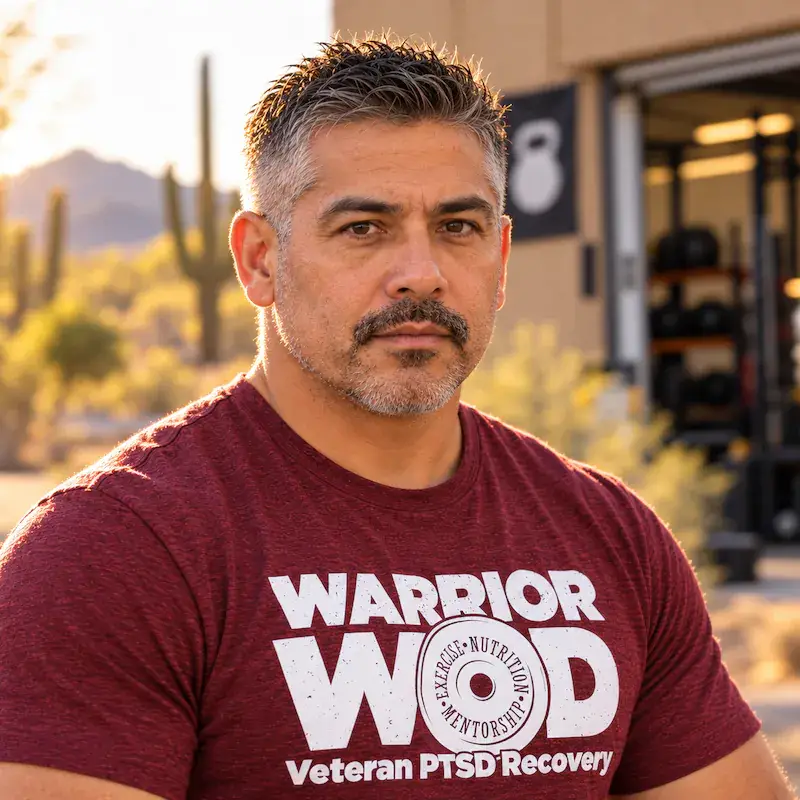
WarriorWOD taught me that I’m capable of overcoming my mental barriers. The program’s support has empowered me to believe in myself again. The mentorship and community have been pillars in my mental health recovery.
I did two deployments. When I got out I worked nights so I wouldn’t have to sleep when everybody else did. My wife called it my schedule. I called it fine.
Month three, I slept six hours straight. First time in about two years. I texted my Battle Buddy at 0500 to tell him. He was already up.
I work days now. I’m at the table for dinner.
My Warrior showed up to intake with his hood up and his back to the wall. I know that look. I wore it for three years.
Week five he told me he was done. I drove to his gym and did the workout next to him. We didn’t talk about it. He was back Thursday.
He graduated in March. I haven’t missed a check-in since I started, and I don’t think that’s only about him.
If you need help now, please contact the Suicide Prevention & Crisis Lifeline or the Veterans Crisis Line.
“WarriorWOD taught me that I’m capable of overcoming my mental barriers. The program’s support has empowered me to believe in myself again. The mentorship and community have been pillars in my mental health recovery.”
–Victoria C.
Who can apply
The six months ask a lot. If you can say yes to everything on this list, the program was built for you.
Questions
No. WarriorWOD is a non-clinical peer-support program. It adds to your therapist, PCP, or VA care. It never replaces them. If you’re in treatment, keep going. If you need care and don’t have it, we’ll help you get connected.
Plan on three workouts, a text with your Battle Buddy, and a call with them every other week. Nutrition sessions run on their own schedule, 24 across the program. Once a month you fill out the Monthly Survey.
Yes. You pay nothing. Each Warrior’s six months costs $1,500, and donors cover all of it. That pays for your gym membership, 24 sessions with a certified Nutrition Coach, InBody scans at intake and graduation, and your Battle Buddy.
Yes. There is one workout, scaled to you: Rx, Scaled, Masters, or Beginner. Bring a workout you can do now, even a 20-minute walk. Progress is measured every 4 weeks, not every session.
Text your Battle Buddy. One missed workout is nothing. If you fall below a requirement, you get a call and a written Notice of Concern with time to fix it. Real-life situations get a Grace Plan. Going silent is the one thing we can’t work with.
Yes. Every Warrior signs a program agreement during onboarding. It lays out the plan, the minimum requirements, and what we commit to you.
We review your veteran PTSD program application. As your Warrior Class approaches, we call you for a phone screen. Then onboarding: the agreement, intake, your gym, and your matches. You start at Kickoff.
That happens. Doing the work can stir things up before they settle. Your Nutrition Coach and Battle Buddy adjust the plan with you.
Staff will call you within 24 hours. It’s a call to help, not a penalty, and you won’t lose your spot. Your Battle Buddy is trained in VA S.A.V.E. If you’re in crisis right now, dial 988 and press 1.
What you tell your Battle Buddy or Coach stays inside the program, except when your safety is at risk. We never share identifying details publicly. Using your photo, quote, or story requires your written consent every time.
No. The program is open to all US military veterans regardless of discharge status. You need to be living with PTSD, suicidal ideation, or substance misuse, and ready to commit to all 26 weeks, including three workouts a week.
Yes. Graduates can serve as a Battle Buddy, a Nutrition Coach candidate, or an Ambassador. Every Battle Buddy is a veteran who completed the six-month program and is trained in VA S.A.V.E. suicide prevention.
Train. Heal. Reconnect.
Leave your email and we’ll tell you the day applications reopen.
Veterans Crisis Line: Dial 988, Press 1. Text 838255. Someone is there right now.