
Battle Buddy veteran mentor program
The Battle Buddy program pairs an active duty service member or veteran with one Warrior for all six months of the program. You text every week, call every two weeks, and check in face-to-face as often as you can.
You don’t need a counseling background. You need to have served, and you need to keep showing up when month three gets hard.
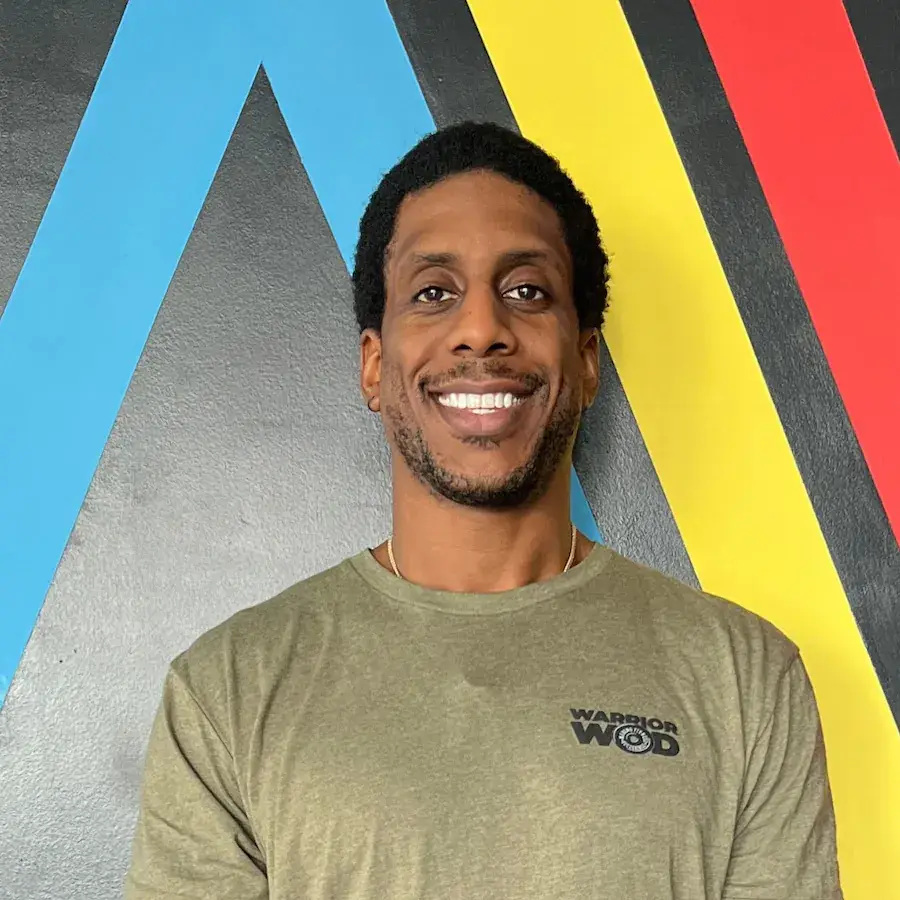
“I connected with WarriorWOD as a battle buddy to support other veterans in rebuilding their strength and resilience, knowing how fitness can transform lives and seeing how WarriorWOD made that a primary focus.”
Who can apply
Battle Buddies are active duty US military service members and US military veterans. All are VA S.A.V.E.-certified.
You don’t have to be a WarriorWOD graduate. Some Battle Buddies came through the program and some didn’t. Every one of them completes VA S.A.V.E. suicide prevention training and commits to the full six months: a text every week, a call every two weeks, and face-to-face check-ins as often as distance allows.
The cadence
One Warrior, intake to graduation.
Low pressure. Just enough to stay in touch.
Open questions, real listening, and a safety check.
A workout, a walk, or coffee. In-person check-ins carry the most weight.
Every text, call, and visit gets a short log so the Program Director knows who needs more support.
If your Warrior goes quiet, contact goes up, not down. Three low-pressure touches across five days. Two silent weeks in a row, and the Program Director gets looped in.
Intake. An InBody scan, the first Monthly Survey, and 12 orientation modules to work through. New gym, new people, and plenty of reasons to walk back out the door.
Coffee before anything else. Ask what they actually want out of this. Swap numbers and backup contacts, set the first call, and put the first face-to-face on the calendar.
Gym twice a week at a Preferred Partner Gym, sessions with their Nutrition Coach, and a Monthly Survey every month that includes the PCL-5 and C-SSRS.
Text every week, call every two weeks, and get face-to-face whenever you can. Back up the habit their Nutrition Coach set that week.
The Program Director reviews their monthly PCL-5 and C-SSRS scores with them. The early energy is gone, and this is the stretch when people think about quitting.
If they go quiet, you lean in. More contact, not less. This is the stretch where showing up counts most.
Final Monthly Survey, a graduation InBody scan, a final score review with the Program Director, and graduation with their Warrior Class. Same start date, same finish line.
Be there for it. Then ask whether they want to be a Battle Buddy for the next Warrior Class.
“You are not a therapist. You are the person a Warrior actually picks up the phone for. That is not a small thing.”
Scope
Why peer mentorship
Tsai et al. (2016) found veterans with peer mentors show 35% greater PTSD symptom reduction and 27% less depression than those without.
That’s why the Battle Buddy veteran mentor role is one of three parts of the six-month veteran PTSD program, alongside exercise and nutrition coaching. Progress is tracked with the PCL-5 every month.
Backup
Battle Buddy training and VA S.A.V.E. suicide prevention certification come before any match.
A weekly cadre call with other Battle Buddies, a monthly one-on-one with the Program Director, and a quarterly case review.
Any safety concern reaches the Program Director within an hour. Licensed clinical care sits behind them. You connect. Professionals treat.
Need a week off calls? Take it. The program holds coverage. Off-hours crises go to the Veterans Crisis Line first, then you.
Apply
Three short steps. We confirm your service, get you into Battle Buddy training and VA S.A.V.E. certification, and match you when the next Warrior Class starts.
Apply to the Warrior Class. Not military? You can still volunteer at events or with professional skills.
Thanks, . Someone from the team will reach out about VA S.A.V.E. training and your match.
FAQ
Something not covered? Email [email protected].
Last updated October 2, 2026
WarriorWOD’s Battle Buddy program pairs one trained veteran or active duty service member with one Warrior for the full six-month veteran PTSD program. The Battle Buddy texts every week, calls every two weeks, and checks in face-to-face as often as possible. Every Battle Buddy completes VA S.A.V.E. suicide prevention training first.
Active duty US military service members and US military veterans who complete VA S.A.V.E. suicide prevention training and commit to the full six months with one Warrior.
No. Some Battle Buddies are WarriorWOD graduates and some are not. Every Battle Buddy has served, completes VA S.A.V.E. training, and commits to the full six months.
Every Battle Buddy completes Battle Buddy training, including VA S.A.V.E. suicide prevention certification, before being matched with a Warrior.
You stay with one Warrior for the full six months. You text every week, call every two weeks, and check in face-to-face as often as you can. You also join a weekly cadre call with other Battle Buddies.
No. Battle Buddies are trained peers, not clinicians. You reinforce the habits your Warrior’s Nutrition Coach sets and make a warm handoff to their clinical provider when needed. Staff administer the PCL-5 and C-SSRS.
WarriorWOD matches you with a Warrior in an upcoming Warrior Class once your service and training are confirmed.
Dial 988 and Press 1 for the Veterans Crisis Line, and stay with them. Then contact the Program Director within one hour. Battle Buddies are trained in the S.A.V.E. protocol and are never expected to handle a crisis alone.
No. Battle Buddies are trained volunteers.
For veterans
A lot of us have been there. WarriorWOD isn't therapy, and it's not a gym membership. It's six months of exercise, nutrition coaching, and a Battle Buddy who's already walked this road. It costs you nothing. You pick the gym. You start with the next Warrior Class.
Apply. It takes ten minutes. You can stop there.
If tonight is the hard part, this page can wait. Dial 988 and press 1, or text 838255. Someone who gets it picks up. Come back to us tomorrow.
Acceptance is application-based. 100 to 120 veterans enroll each year across the Warrior Classes.
Join the Mission
They served. You serve them back. For $22 a month, you're in a veteran's corner for every workout, every check-in, and every Battle Buddy call of the six-month program. Over a year, your $264 covers more than a sixth of one veteran's complete recovery. Veterans pay nothing. Donors like you cover all of it.
Every dollar is tracked to a measured outcome. The PCL-5 is scored every month. The data belongs to the literature, not to us.

"I read the research page before I gave anything. The College of Charleston study was done independently. WarriorWOD doesn't review it before it's released. That detail mattered to me. Most nonprofits fund research to confirm what they already believe. These guys said 'check our work.' So I did. I give $22 a month. Six of us at that level fund one veteran's complete six-month recovery. That's the math."
Questions, answered with data
WarriorWOD Foundation combines exercise, nutrition, and peer mentorship in a research-backed, results-driven six-month recovery program for US military veterans facing PTSD, suicidal ideation, and substance misuse. Warriors train at a Preferred Partner Gym, receive nutrition coaching, and are paired with a Battle Buddy who completed the program. Acceptance is application-based and veterans pay nothing.
Yes. The College of Charleston (Dr. Katie Trejo Tello, Ph.D., Department of Public Health Sciences and Administration) ran the evaluation under separate grant funding, SCTR CES-P UM1TR005294. WarriorWOD did not fund it and did not review the findings before release. The study found a 14.42-point PCL-5 reduction (p<.001, Cohen's d=1.33, n=21 matched pairs). Peer review is pending.
WarriorWOD measures PTSD outcomes using the PCL-5 (PTSD Checklist for DSM-5) and C-SSRS (Columbia-Suicide Severity Rating Scale), both validated instruments used by the VA and DoD, administered at intake and every month throughout the six-month program. Among 265 completers, overall PTSD symptom severity declined 38.25%: Avoidance 35.39%, Hyperarousal 39.66%, Negative Alterations in Cognition 40.38%, Intrusive Re-experiencing 36.33%.
US military veterans living with PTSD, suicidal ideation, or substance misuse who can take part in structured fitness. Acceptance is application-based. Each Warrior Class shares a start date, shared training, and a shared graduation. Apply to the Warrior Class.
A real part of one veteran's complete six-month recovery. Over a year, $22 a month is $264, more than a sixth of the $1,500 it costs to put one veteran through the program: nutrition coaching ($600), gym membership ($575+), programming ($125), InBody assessments ($100), support ($75), and mentorship ($25). If 500 Warrior Supporters gave $22 a month, WarriorWOD could fund 88 more veterans a year. Veterans pay nothing. Join the Mission.
You may not have been in the fight, but you can be on the team. Join the monthly donors funding the next 265 recoveries.
NO ONE FIGHTS ALONE.