The program · How it works

Six months, measured monthly. How WarriorWOD’s veteran support programs work.

A lot of veteran support programs give you one piece: a gym membership, a counselor, a support group. WarriorWOD runs three at once for 26 weeks. Warriors train, work with a Nutrition Coach, and lean on a Battle Buddy who already finished. Every month we check PTSD symptoms and safety, and an outside university checked the results.

14.42
point PCL-5 drop, independently verified by the College of Charleston
d = 1.33
effect size, well past the 0.8 mark for “large”
265
veterans have completed the full six months
9 of 9
Warriors who entered with suicidal ideation are alive

The model

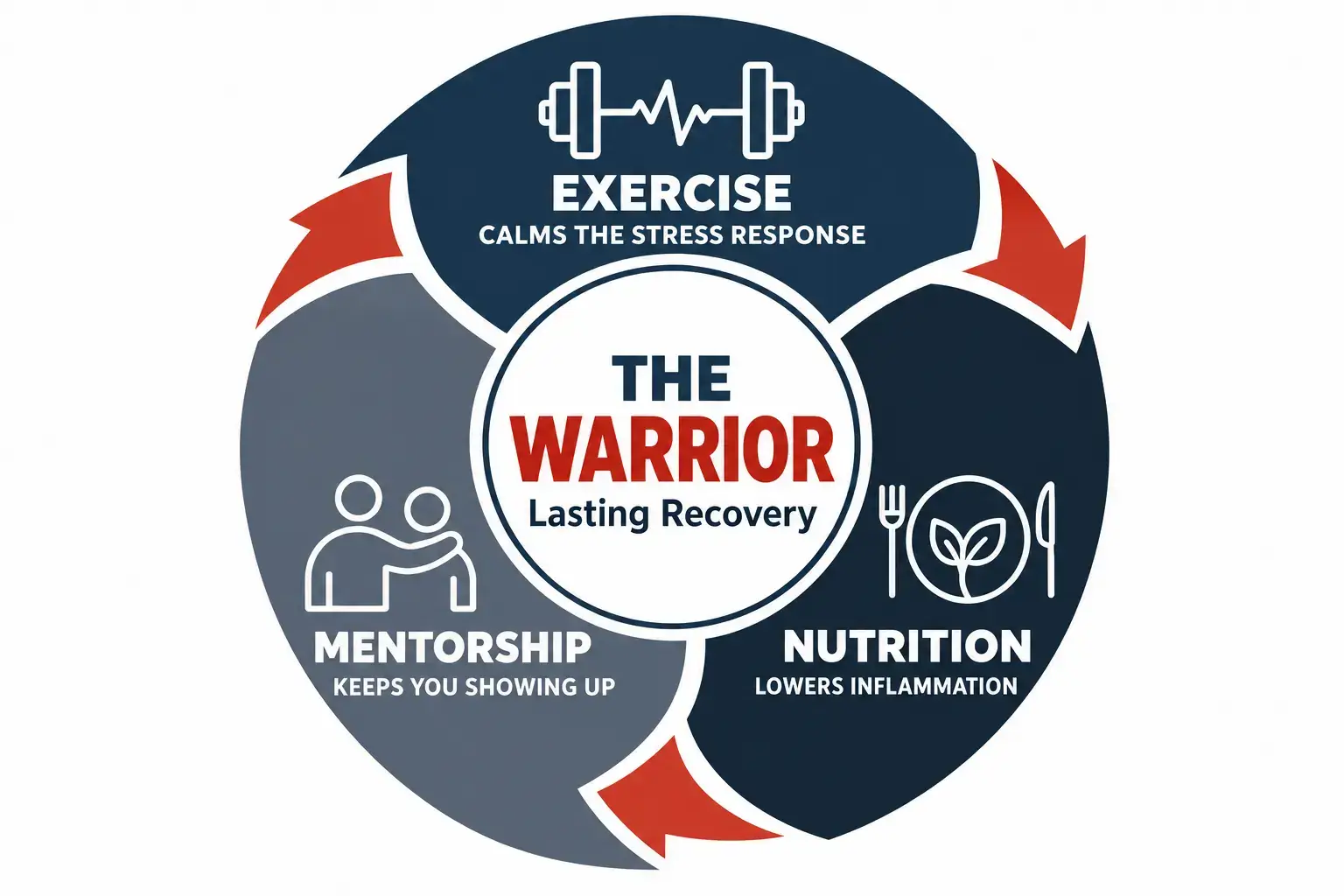
Three parts, run as one: how our veteran support programs fit together


WarriorWOD Foundation combines exercise, nutrition, and peer mentorship in a research-backed, results-driven six-month recovery program for US military veterans living with post-traumatic stress, suicidal ideation, and substance misuse.

WarriorWOD veteran support programs model: exercise, nutrition, and mentorship work as one cycle around the Warrior for lasting recovery

Why we run all three together

Each part has its own research behind it. We put them in the same six months because each one makes the other two easier to keep doing.

Exercise + Nutrition = fuel and recovery

Three workouts a week take energy. Coaching on what you eat gives you the energy to train and recover between sessions.

Exercise + Mentorship = accountability

Someone who finished the same workouts notices when you skip a week, and texts you about it.

Nutrition + Mentorship = habits that stick

Small food changes are easier to keep when a peer is checking in every week and a coach is adjusting the plan.

All three, measured monthly

The Monthly Survey tracks PTSD symptoms and safety, so the plan changes when the numbers do.

01 · Exercise

Training is a primary treatment for PTSD symptoms, not an add-on.

Aerobic training regulates the hypothalamic-pituitary-adrenal (HPA) axis, promotes BDNF production, and reduces neurobiological hyperarousal: the three mechanisms driving most PTSD symptom clusters.

The Warrior’s part: three workouts a week at a gym they pick, scaled to them.

02 · Nutrition

What you eat changes how your brain handles stress.

Omega-3 fatty acids reduce the neuroinflammation linked to both PTSD and depression. Anti-inflammatory diets lower cortisol dysregulation. Stable blood glucose supports the executive function that veterans lose to hypervigilance.

The Warrior’s part: 24 one-on-one sessions with a certified Nutrition Coach.

03 · Mentorship

Veterans don’t distrust treatment. They distrust people who weren’t there.

Battle Buddies are US military veterans who completed the WarriorWOD six-month program, so this is peer support for veterans from people who finished it. All are trained in VA S.A.V.E. suicide prevention.

The Warrior’s part: a text every week, a call every two weeks, face to face monthly if they live close.

WarriorWOD is non-clinical mental health support for veterans. It works alongside a Warrior’s therapist, doctor, or VA care and never replaces them.

For veterans · Week by week

Inside the 26 weeks of our veteran help program


Your whole Warrior Class starts on the same day and graduates on the same day. Here’s a normal week, and what happens from application to graduation.

3 workouts
That’s the plan. Two a week is the minimum.
Battle Buddy text
Every week, plus a call every two weeks.
Nutrition sessions
24 across the program, on your coach’s schedule.
Monthly Survey
Once a month: symptoms and safety.
Before Week 1

Apply, phone screen, onboard

We review every application. As your Warrior Class gets close, we call you. You sign the program agreement and finish intake: PCL-5, C-SSRS, a health and nutrition baseline, and an InBody scan. You list your current providers so we can coordinate. We set up your gym and match you with your Battle Buddy and Nutrition Coach.

Week 1

Kickoff

Your class starts together. You begin the 12 orientation modules and set one goal you’d bet a friend on.

Months 1 to 3

Build the routine

Train, eat, connect, report honestly. Your coach starts from what you eat now and adds small habits. Your first Monthly Survey comes at the end of month one.

Week 13

Midpoint review

You sit down with your Program Director, look at your numbers, and adjust the plan for the second half.

Months 4 to 6

Hold the line

This is where people drift, and where your Battle Buddy matters most. Fall below a requirement and you get a call and a written Notice of Concern with time to fix it. Real-life situations get a Grace Plan.

Week 26

Graduate

Final review, final Monthly Survey, and a second InBody scan. You don’t have to be fixed. You have to have walked the 26 weeks.

After

Alumni check-ins, and a way back in

We check in at 30, 60, and 90 days after graduation. Graduates can come back as a Battle Buddy for the next class.

“WarriorWOD taught me that I’m capable of overcoming my mental barriers. The program’s support has empowered me to believe in myself again. The mentorship and community have been pillars in my mental health recovery.”

–Victoria P.

WarriorWOD Veteran PTSD Recovery Logo- White

For veterans · Your corner

Veteran peer support and coaching: who’s in your corner for six months


Your Nutrition Coach

A certified Nutrition Coach works with you one-on-one for 24 sessions. They start from what you eat now and build small habits from there. Nobody hands you a diet and walks away.

▸One-on-one, on its own calendar alongside your training
▸One change at a time, starting with what you already eat
▸InBody scan at intake and graduation to show what changed

Your Battle Buddy

A US military veteran who completed WarriorWOD and is trained in VA S.A.V.E. suicide prevention. You’re matched during onboarding, before Kickoff. They aren’t a therapist, a coach, or a veterans support group. They sat where you’re sitting and finished. It’s veterans helping veterans, one on one.

▸Text every week
▸Call every two weeks, the minimum
▸Face to face once a month, if geography allows

Finished the program? Read about the Battle Buddy volunteer role.

Measurement protocol

How we measure progress, every month


WarriorWOD measures PTSD outcomes using the PCL-5 (PTSD Checklist for DSM-5) and C-SSRS (Columbia-Suicide Severity Rating Scale), both validated instruments used by the VA and DoD, administered at intake and every month throughout the six-month program. Every Warrior ends up with a monthly record, not a single before-and-after snapshot.

ToolWhat it measuresWhen
PCL-5PTSD symptom severity, 0 to 80Intake, then every month
C-SSRSSuicide riskIntake, then every month. A yes means a staff call within 24 hours.
InBody scanBody compositionIntake and graduation
Program Director reviewNumbers and planWeeks 13 and 26
Alumni check-inHow graduates are holding up30, 60, and 90 days after Week 26

A score that goes up one month isn’t failure. Doing the work can stir things up before they settle, and the coach and Battle Buddy adjust the plan. A yes on the safety screen never costs a Warrior their spot.

For veterans

Applications are paused. The next Warrior Class is full.

Leave your email and you’ll hear from us the day applications reopen. Read what the program asks of you first.

For donors and funders · The evidence

Funding veteran support programs built on peer-reviewed research


The research existed before we did. We built the program to match it. Here is the study behind each part, what it found, and how the Warrior Class puts it to work.

Exercise
1,039 trials

An umbrella review in the British Journal of Sports Medicine pooled 97 systematic reviews covering 1,039 trials and 128,119 adults. Physical activity improved depression, anxiety, and distress, and the authors reported it was about 1.5 times as effective as counseling or leading medications.

How we apply it: three workouts a week for 26 weeks, scaled to each Warrior.

Singh B, et al. Br J Sports Med. 2023;57:1203-1209.

Nutrition
Diet ↔ PTSD

Researchers at Brigham and Women’s Hospital and Harvard Chan School studied 191 women in the Nurses’ Health Study II. Higher PTSD symptom levels went with less adherence to a Mediterranean-style diet and with differences in the gut microbiome.

How we apply it: 24 one-on-one sessions that build anti-inflammatory eating habits.

Ke S, et al. Nature Mental Health. 2023;1:900-913.

Mentorship
35% greater

Veterans with peer mentors show 35% greater PTSD symptom reduction and 27% less depression than those without. Trust built on shared experience is the mechanism.

How we apply it: every Warrior gets a Battle Buddy who already graduated, trained in VA S.A.V.E.

Tsai et al. (2016), Psychiatric Services.

For donors and funders · Independent evaluation

How the College of Charleston tested the program


An independent evaluation by the College of Charleston (Dr. Katie Trejo Tello, Ph.D., grant SCTR CES-P UM1TR005294) found a statistically significant 14.42-point reduction in PCL-5 PTSD scores among WarriorWOD program completers (pre: 43.37, post: 28.95; p<.001, Cohen’s d=1.33, n=21 matched pairs). Post-program scores fell below the 31 to 33 clinical threshold for probable PTSD.

Who ran itDr. Katie Trejo Tello, Ph.D., Associate Professor, Public Health Sciences and Administration, College of Charleston
Who paidSCTR grant CES-P UM1TR005294. Not WarriorWOD.
DesignPCL-5 at intake and graduation, compared for the same 21 Warriors (matched pairs)
IndependenceWarriorWOD did not review the findings before release
StatusPeer review pending. A small sample with no control group, which is why we also track every Warrior internally.
Average PCL-5 score (0 to 80)
At intake
43.37
At graduation
28.95
Clinical threshold for probable PTSD (31 to 33)
14.42
points. The VA’s National Center for PTSD treats a 10 to 20 point change as clinically significant.
1.33
Cohen’s d. By convention, 0.8 or more counts as a large effect.

For donors and funders · 265 completers

Results across all four PTSD symptom clusters


Among 265 US military veterans who completed WarriorWOD’s six-month recovery program, overall PTSD symptom severity declined 38.25% across all four DSM-5 clusters: Avoidance 35.39%, Hyperarousal 39.66%, Negative Alterations in Cognition 40.38%, Intrusive Re-experiencing 36.33%.

Negative thinking and mood40.38%
Guilt, blame, feeling cut off from people, losing interest in things you used to care about.
Hyperarousal39.66%
Always on guard, jumpy, short temper, trouble sleeping or concentrating.
Intrusive memories36.33%
Flashbacks, nightmares, unwanted memories that show up without warning.
Avoidance35.39%
Staying away from people, places, and conversations that bring it back.
Overall severity38.25%
Reduction in PCL-5 cluster scores, intake to graduation. Bars drawn on a 0 to 50% scale.
90.4%
of completers saw their PTSD symptoms go down
9 of 9
veterans who entered with suicidal ideation are alive today
15%
reduction in substance use

Delivered in 38+ states across 12 Warrior Classes. See the full independently verified outcomes.

For funders · Theory of change

From a donor dollar to a measured outcome


1 · Inputs

$1,500 per veteran in donor funding. Gym memberships. Certified Nutrition Coaches. VA S.A.V.E.-trained Battle Buddies. Program staff. An independent evaluator.

2 · Activities

Three workouts a week for 26 weeks. 24 nutrition sessions. Weekly Battle Buddy texts and calls every two weeks. Monthly PCL-5 and C-SSRS. Reviews at Weeks 13 and 26.

3 · Outputs

265 veterans have completed the full program, across 12 Warrior Classes in 38+ states. Every Warrior has a monthly clinical record.

4 · Outcomes

A 14.42-point PCL-5 reduction, independently verified. 38.25% lower overall PTSD severity. 90.4% of completers improve. Substance use down 15%.

5 · Impact

The average Warrior finishes below the clinical PTSD threshold. All 9 who entered with suicidal ideation are alive. Graduates return as Battle Buddies for the next class.

Questions · Veterans and supporters

Questions about our veteran support programs


Straight answers for veterans thinking about the Warrior Class and for the people who fund it.

What are WarriorWOD’s veteran support programs?

WarriorWOD’s veteran support programs combine exercise, nutrition coaching, and peer mentorship in one six-month program for US military veterans. Each Warrior Class starts and graduates together over 26 weeks. In practice, that means three workouts a week, 24 nutrition sessions, and a Battle Buddy who already finished, with PTSD symptoms and safety checked every month.

Who can join the Warrior Class?

The Warrior Class is for US military veterans living with PTSD, suicidal ideation, or substance misuse who can take part in structured fitness, scaled to their level. You also need to commit to the full 26 weeks and the monthly check-ins. Read what the program asks of you before you apply.

What does the program cost a veteran?

Accepted Warriors pay nothing. Each veteran’s six months costs $1,500, and donors cover all of it: gym membership, nutrition coaching, programming, InBody scans, and Battle Buddy support. As a result, money is never the reason a veteran can’t start.

What is a Battle Buddy?

A Battle Buddy is a US military veteran who completed the WarriorWOD program and is trained in VA S.A.V.E. suicide prevention. They text you every week, call every two weeks, and meet face to face once a month if you live close. They aren’t a therapist. Instead, they’re someone who sat where you’re sitting and finished.

Does WarriorWOD replace therapy or VA care?

No. WarriorWOD is non-clinical mental health support for veterans, and it works alongside your therapist, doctor, or VA care. At intake you list your current providers so we can coordinate. If a monthly safety screen comes back yes, a staff member calls within 24 hours. In a crisis, dial 988, then press 1.

How does WarriorWOD measure progress?

Every Warrior completes the PCL-5 (PTSD symptoms) and the C-SSRS (suicide risk) at intake and every month after. An InBody scan runs at intake and graduation. Your Program Director reviews your numbers at Weeks 13 and 26. After graduation, we check in at 30, 60, and 90 days.

What did the College of Charleston evaluation find?

Dr. Katie Trejo Tello of the College of Charleston found a 14.42-point drop in PCL-5 scores among program completers, from 43.37 to 28.95 (p<.001, Cohen’s d=1.33, n=21 matched pairs). Scores fell below the 31 to 33 clinical threshold. The study was funded by SCTR grant CES-P UM1TR005294, not WarriorWOD, and peer review is pending.

What results have Warriors seen?

Among 265 veterans who completed the full six months, overall PTSD severity dropped 38.25% across all four symptom clusters, and 90.4% saw their symptoms go down. Substance use fell 15%. All 9 veterans who entered with suicidal ideation are alive today. The program has run in 38+ states across 12 Warrior Classes.

How does a $22 monthly gift help?

A $22 monthly gift adds up to $264 a year toward a Warrior’s gym, coaching, and Battle Buddy. Six Warrior Supporters at $22 a month fund one veteran’s complete six-month recovery each year. If you’d rather fund a whole Warrior yourself, $125 a month covers one complete recovery.

Can foundations and grantmakers get outcome data?

Yes. WarriorWOD Foundation is a 501(c)(3), EIN 87-1065126. Funders can request the full College of Charleston evaluation, monthly outcome data, and the itemized $1,500 per-veteran budget through foundation and grant inquiries.

Are applications open right now?

Not yet. The next Warrior Class is full, so applications are paused. Leave your email and you’ll hear from us the day applications reopen. Meanwhile, if you need support today, dial 988, then press 1.

They served.
Now stand with them.

You may not have been in the fight, but you can be on the team. Join the monthly donors funding the next 265 recoveries.

NO ONE FIGHTS ALONE.